
The grape harvest has ancient origins, and the discovery of organic residues in jars found in Sicily has led to the belief that wine production in this region is among the oldest in the world, dating back at least six thousand years.
The ancient Romans dedicated a festival to the grape harvest , the “ Vinalia rustica ”, celebrated on August 19th , and this is why even today in the collective imagination the word “ grape harvest ” brings to mind the idea of a celebration.
In a not too distant past, after having established the date of the beginning of the grape harvest , generally no earlier than September 8th, when the wives of the farmers on the southern side of the city-territory of Marsala, on the day dedicated to the Blessed Virgin Mary, brought baskets full of grapes to church for blessing so that the year would be good.
Preparations for the grape harvest involved everyone, regardless of age or gender.
The boys helped the adults clean the containers for harvesting the grapes “ cartedde ”, and put away the tools, scissors, funnels and buckets.
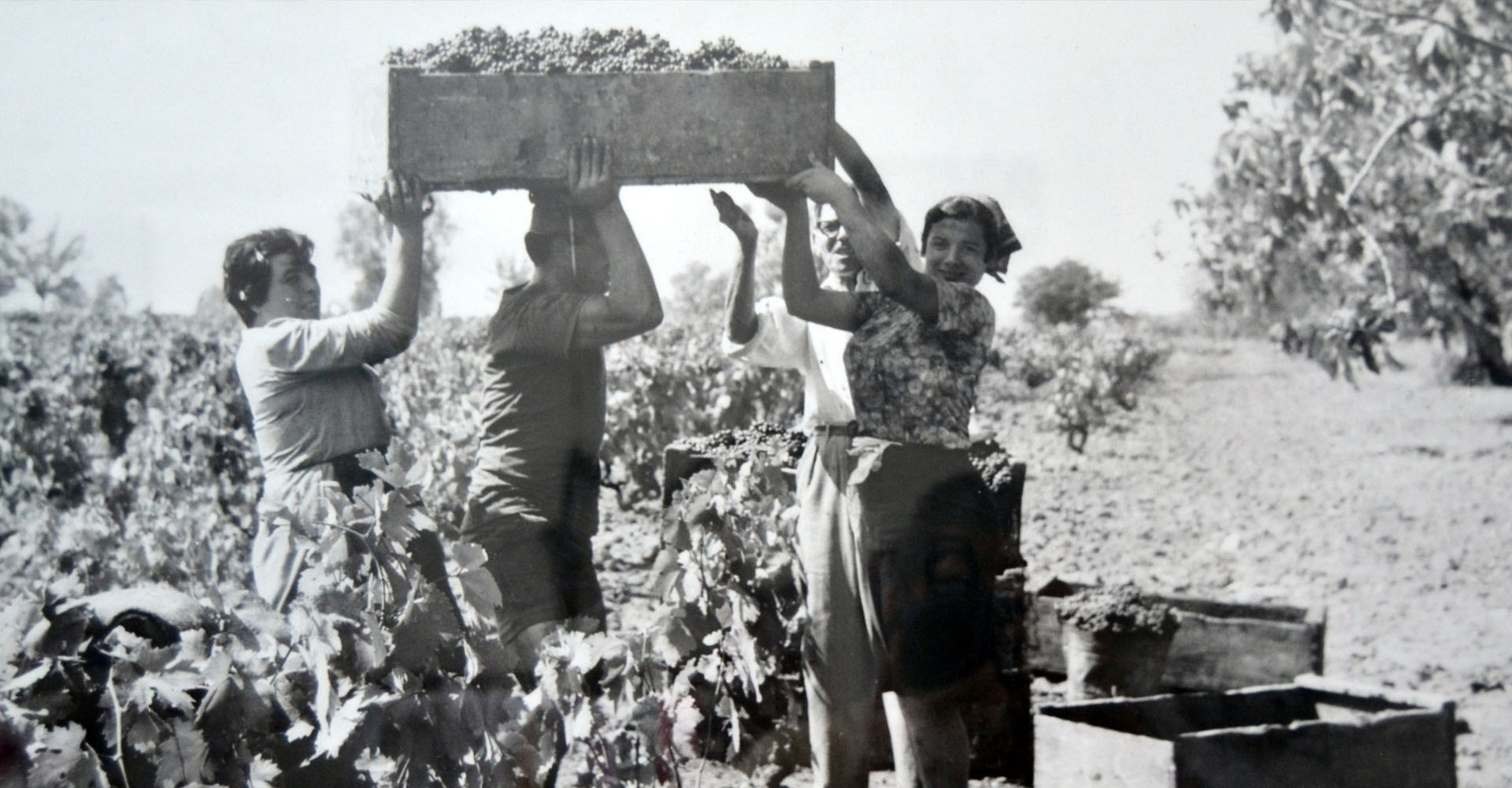
At dawn, men and women with the “ cartedde ” and boys with the “ panareddi ” went to the countryside to pick the grapes.
Once the baskets were full, they were placed at the edges of the rows where the “ carricaturi ” emptied them into the “ tineddi ” (oval wooden containers corresponding to half a barrel) which were placed in the centre of the “ carretto ” ( typical Sicilian cart ).
When the “ tineddo ” was full, the grapes were unloaded onto the “ paramento ” ( palmento ) connected to the “ scarricatura ” (openings on the palmento to allow the grapes to descend from the carts).
Then came the “ pigiatura ”: barefoot men with large boots who, holding on to ropes hanging from the ceiling, crushed the grapes, keeping time.
At a certain point, the first pressing of the “ free-run must ” began to flow from the “ well ” connected to the palmento and it was joy for everyone.
In the meantime, the remains of the crushed grapes were placed inside the “ coffe ” (containers made of woven vegetable fibres) which were pressed, first in the “ viti ” ( presses ) placed one on top of the other (about ten coffe ) and, then, from the 1900s in the “ torchiu ” ( press ) until only the dry residues remained: the “ vinazzu ” which was kept in the open air and gradually given to domestic animals.
On grape harvest days, meals were eaten among the rows or in the atrium of the manor house called “ bagghiu ”.
The bread was accompanied with salted sardines or with olives and tomatoes.
The hot meal was eaten in the evening at home: the women returned from the grape harvest early or sometimes they took turns staying at home to prepare dinner and the men, after having washed themselves in the ” tubs ” with water from the well, they gathered to consume the home-made dry pasta “ lasagni or tagghiarini , gnocculi , busiati or maccarruna ”.
The pasta, seasoned with tomato sauce, cooked with onion and garlic browned in oil and basil, was poured into a wooden container called “ maidda ” which was placed in the centre of the table and everyone could help themselves as they liked.
The second course was meat-based, usually home-raised chicken or minced meatballs, sometimes grilled sardines.
After dinner, despite being tired, everyone spent some time under a large carob tree with jokes, pawn games and serenades, some of them playing the “ fiscalettu ” (a reed flute).
The families: Alagna , Angileri and Caruso of the CANTINE VINCI began to organize the grape harvest already at the end of August with the preparation of presses , vats , pumps , first carts and then trucks , baskets and finally scissors .
The women stayed at home to pluck chickens and prepare the tomato sauce that would be used to prepare dinner for the “graper” workers coming from the more inland areas of Sicily who would have enjoyed the meal washed down with a good, high-proof wine.
Every now and then, busy with their tomato preserves, they invoked God’s will, praying that it would not rain and make the harvest difficult and long.
There was a festive atmosphere and even the children took every opportunity to play with the grapes, loading them onto their trucks, imitating the adults.
The must then passed from the palmento to the barrels where it fermented for a long period awaiting San Martino when ” Every must became wine ” and the fateful moment of tasting arrived which involved everyone.
The head of the family poured the new wine from the barrel into the glass, observed its color, smelled its aroma and finally tasted it.
Then other members of the family also expressed their opinions on the color, the aroma and the taste, demonstrating that a wine is the union of all the generations that cultivate a vineyard.


